Master Spanish by listening, repeating and speaking.
Absorb Spanish vocabulary and grammar naturally.
The Foreign Service Institute (FSI) Spanish Basic Course is the most comprehensive and systematic Spanish course ever made.
This new enhanced edition for iPad and Mac allows you to use this course to its full potential and learn Spanish like never before.
No other Spanish course will give you as much natural practice.
FSI Spanish Basic Course can be used on its own, or as the perfect complement to any other Spanish learning material.
Absorb Spanish vocabulary and grammar naturally.
The Foreign Service Institute (FSI) Spanish Basic Course is the most comprehensive and systematic Spanish course ever made.
This new enhanced edition for iPad and Mac allows you to use this course to its full potential and learn Spanish like never before.
No other Spanish course will give you as much natural practice.
FSI Spanish Basic Course can be used on its own, or as the perfect complement to any other Spanish learning material.
Listen, learn, and repeat the dialogues.
Do the interactive exercises.
Practice the drills at your own pace.
In no time you will be speaking Spanish naturally, with ease and fluency.
Do the interactive exercises.
Practice the drills at your own pace.
In no time you will be speaking Spanish naturally, with ease and fluency.
You can study the complete course or just focus on units you are interested in.
Please refer to the course content to choose a specific unit.
Please refer to the course content to choose a specific unit.
IMPORTANT
FSI Spanish is a massive course. In this enhanced edition, you will find all the components of the original course (sometimes with minor modifications). If you find some parts too difficult, or too repetitive, or not to your taste - don't hesitate to skip them. The vocabulary and the grammatical structures are constantly repeated and will appear again and again. Don't get stuck and don't aim for perfection! Just move forward, and your Spanish will get better and better!
FSI Spanish is a massive course. In this enhanced edition, you will find all the components of the original course (sometimes with minor modifications). If you find some parts too difficult, or too repetitive, or not to your taste - don't hesitate to skip them. The vocabulary and the grammatical structures are constantly repeated and will appear again and again. Don't get stuck and don't aim for perfection! Just move forward, and your Spanish will get better and better!
GENERAL PRINCIPLES
FSI Spanish Basic Course is based on guided imitation and overlearning.
Guided imitation's goal is to teach to speak easily, fluently, with very little accent, and to do this without conscious effort, just as one speaks his own language. This is done by learning to authentically manipulate the sounds, sequences, and patterns of the language through dialogue repetition and drill practice.
Overlearning is learning a relatively small body of material so well that it requires very Iittle effort to produce it. This allows to experience rapid progress in learning the language.
LEARNING STRUCTURE
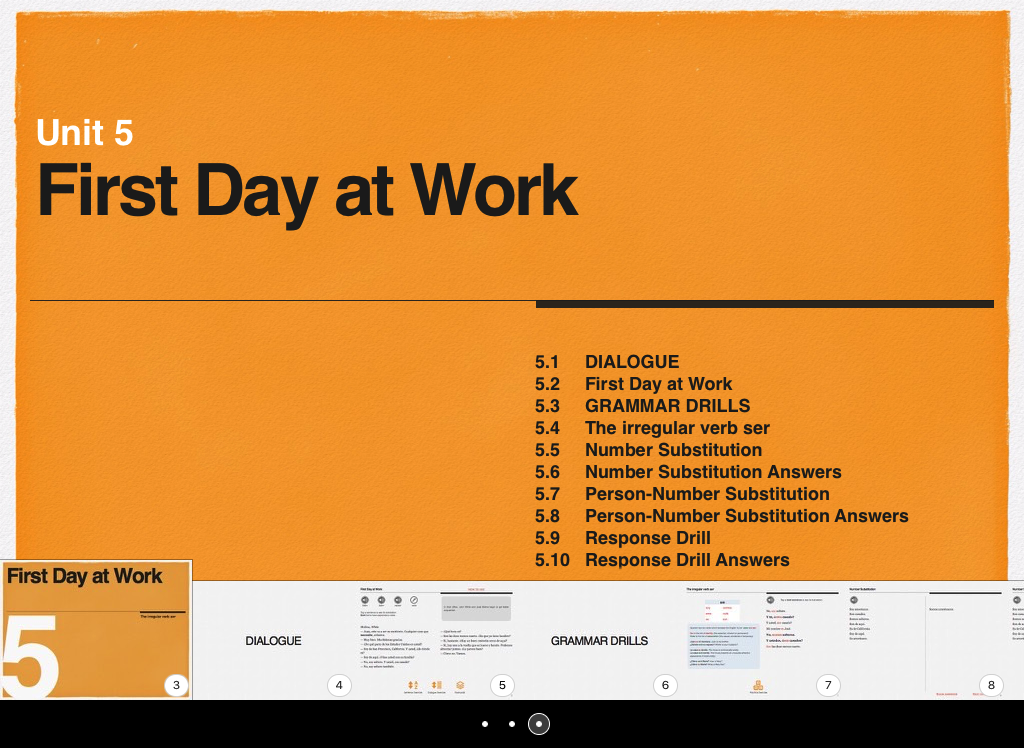
Each unit is divided into clear sections, making for easy navigation and a smooth learning curve.
The main sections are:
The main sections are:
- Dialogues
- Grammar Drills
- Conversation Drills (levels 1-3)
- Review Drills
- Review Dialogues (levels 1-3)
- Readings
PRONUNCIATION
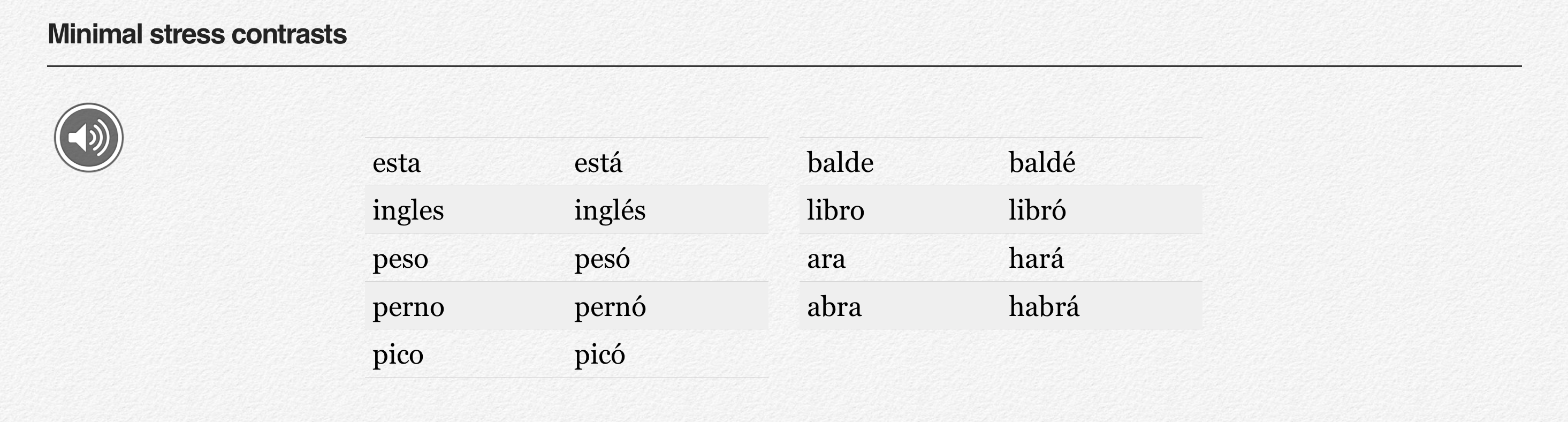
The first two units are focused primarily on pronunciation.
Pronunciation is extremely important. It is the basis of all real fluency. A person is readily able to understand anything he can meaningfully say himself, if the correlation between the way he hears it and the way he says it is reasonably similar. The more similar, the greater the ease of comprehension.
If you are not a beginner, you can skip these sections. You can also focus on specific points problematic to you and skip all the rest. If you are not a native English speaker, skip the drills irrelevant to you.
Listen and repeat a few times each drill, until you feel some improvement. There is no need to aim for perfection. Your pronunciation will get better with time and study.
Pronunciation is extremely important. It is the basis of all real fluency. A person is readily able to understand anything he can meaningfully say himself, if the correlation between the way he hears it and the way he says it is reasonably similar. The more similar, the greater the ease of comprehension.
If you are not a beginner, you can skip these sections. You can also focus on specific points problematic to you and skip all the rest. If you are not a native English speaker, skip the drills irrelevant to you.
Listen and repeat a few times each drill, until you feel some improvement. There is no need to aim for perfection. Your pronunciation will get better with time and study.
DIALOGUES
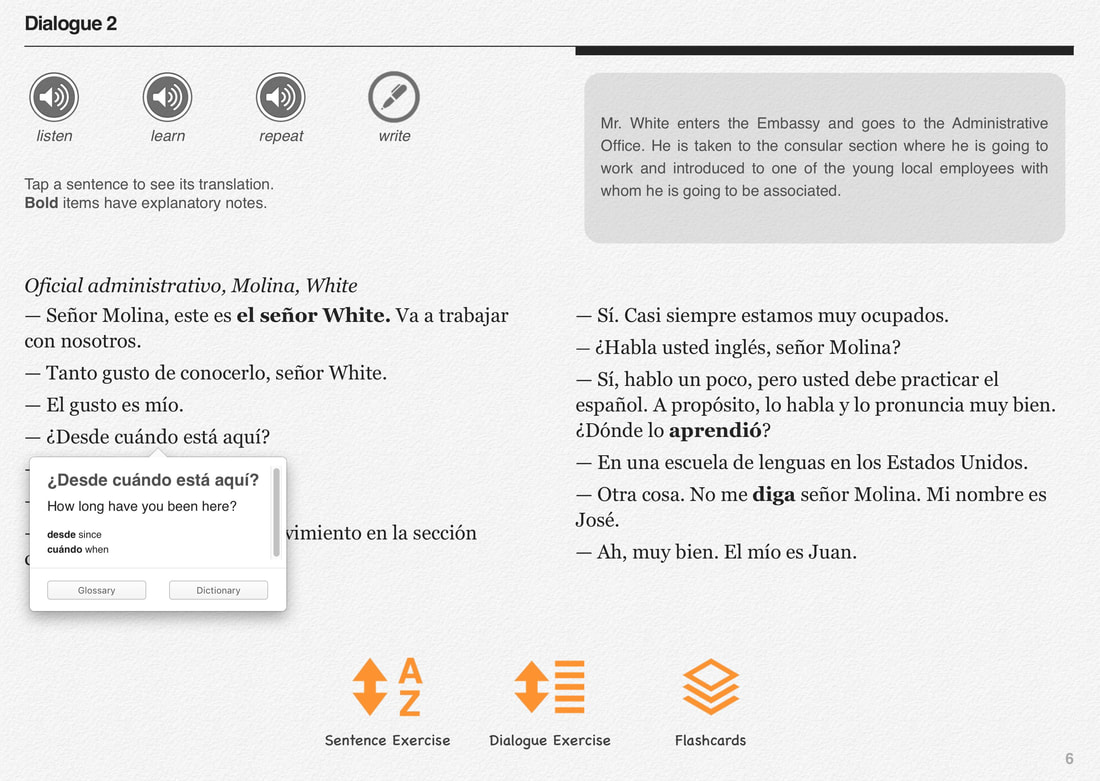
The dialogues are the core of each unit. These dialogues are set in a mythical country called Surlandia, which is described as a typical Latin Amercian republic, insofar as it is possible to extract common features from so diverse an area.
You can tap any sentence to see a pop-over translation, vocabulary breakdown, and notes. All new words are translated and explained when first introduced.
You should practice the dialogues by using the three supplied recordings: Listen, Learn, Repeat.
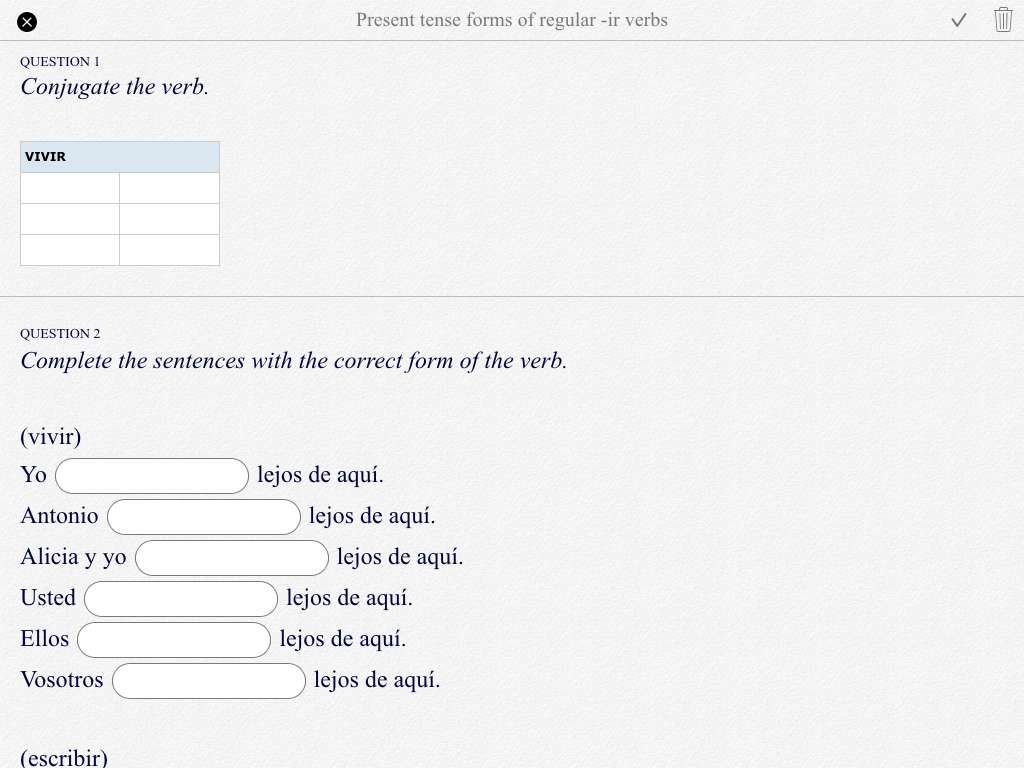
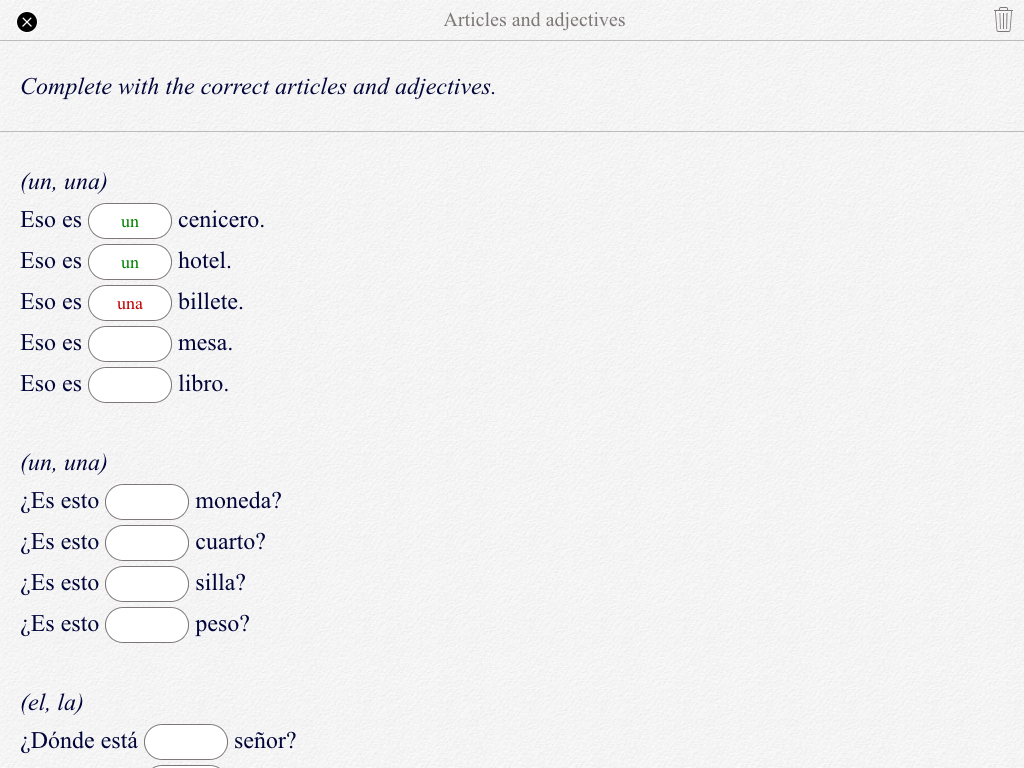
You should complement this oral practice with the accompanying interactive exercises (level 1). All these exercises provide you with instant feedback: a correct answer turns green.
You can tap any sentence to see a pop-over translation, vocabulary breakdown, and notes. All new words are translated and explained when first introduced.
You should practice the dialogues by using the three supplied recordings: Listen, Learn, Repeat.
- Listen: Just listen, do not repeat.
- Learn: Each utterance is build up in reverse from partial utterances. Listen carefully and repeat each item in the pause provided.
- Repeat: Repeat each sentence in the pause provided.
You should complement this oral practice with the accompanying interactive exercises (level 1). All these exercises provide you with instant feedback: a correct answer turns green.
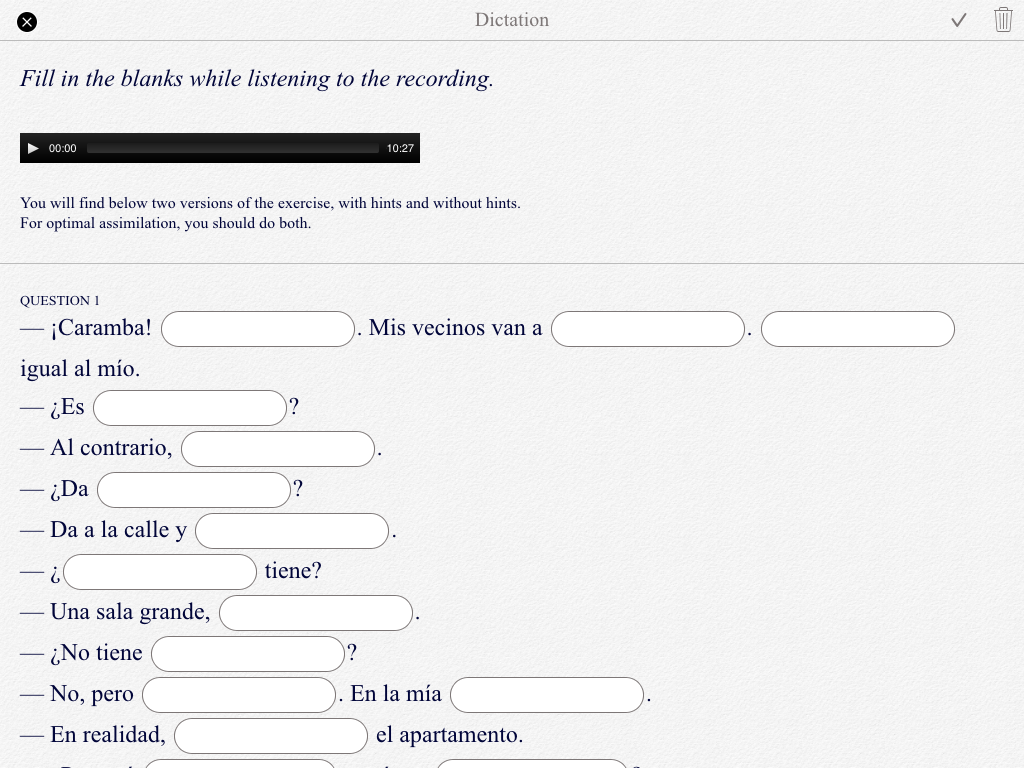
- Write: Write down the dialogue while listening to the 'Learn' audio track. Two versions of the exercise are provided: with hints, and with no hints. For optimal retention of the dialogue, we recommend you do both.
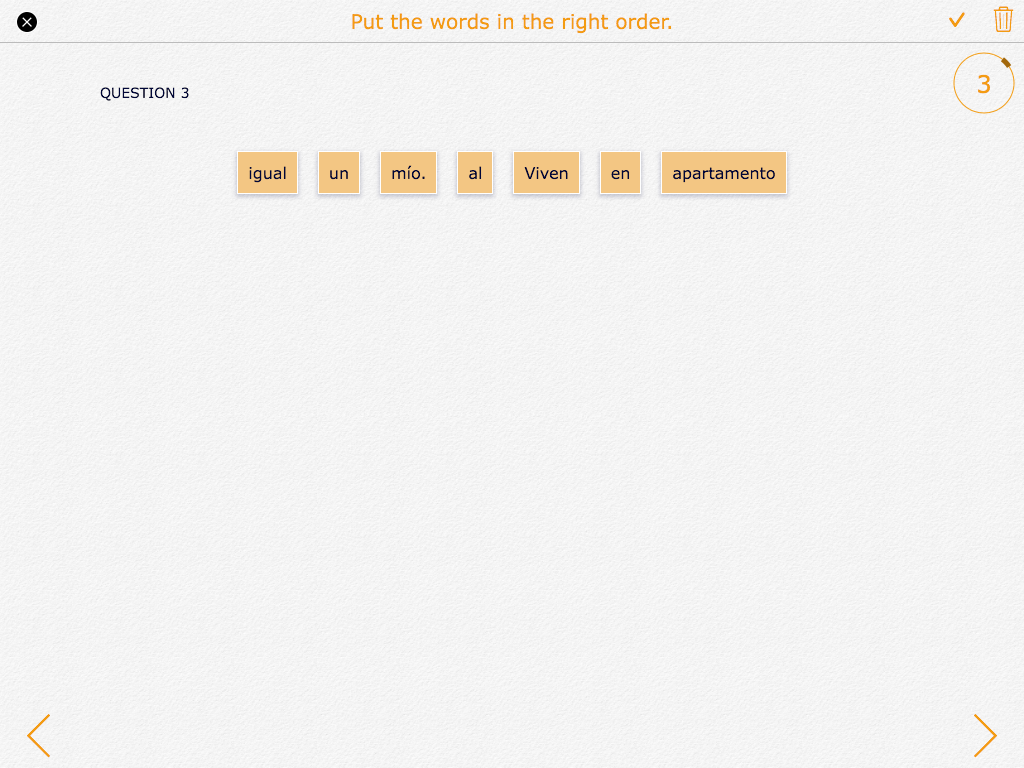
- Sentence Exercise: Put the words of each sentence in the right order. This exercise makes you zoom into the details of the dialogue, and helps you grasp the Spanish sentence structure.
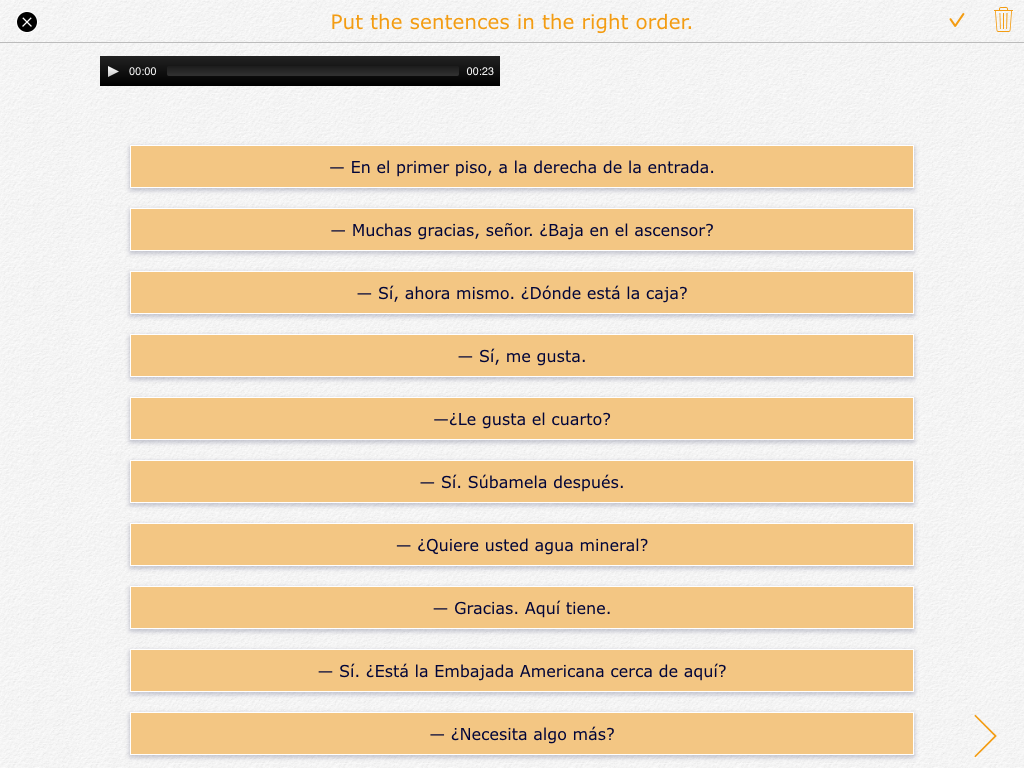
- Dialogue Exercise: Put the sentences of the dialogue in the right order while listening to the 'Listen' audio track. This exercise allows you to feel better the overall flow of the conversation.
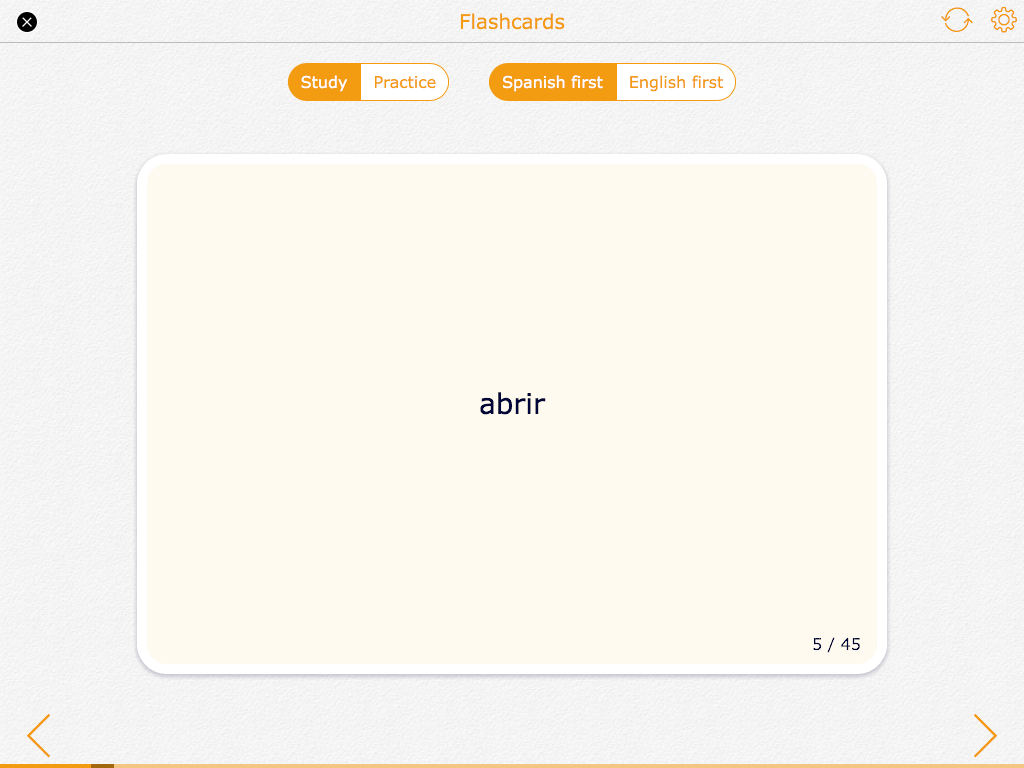
- Flashcards: Practice important sentences and words with flashcards (Spanish-English, English-Spanish). First, learn the cards in 'Study' mode, then test yourself in 'Practice' mode. At the end of your practice, you will be offered to repeat the cards you got wrong (if any). If you wish to test your speed, a timer is available in the settings (the timer is off by default).

GRAMMAR
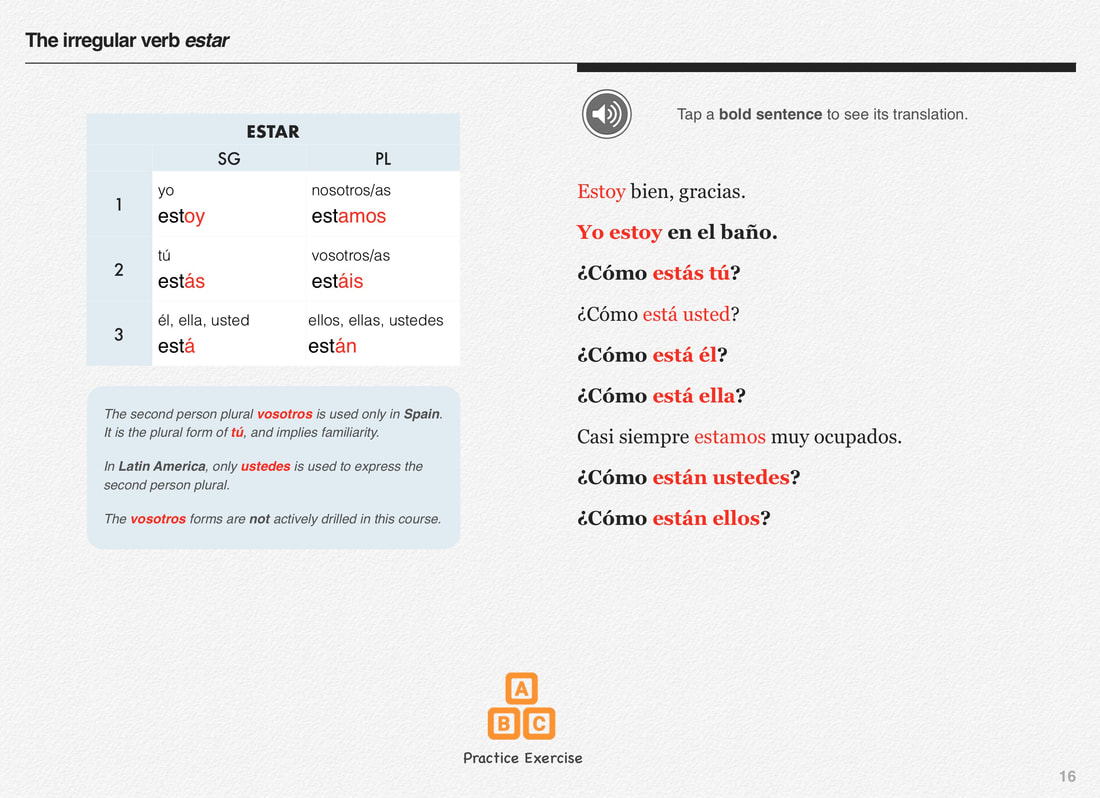
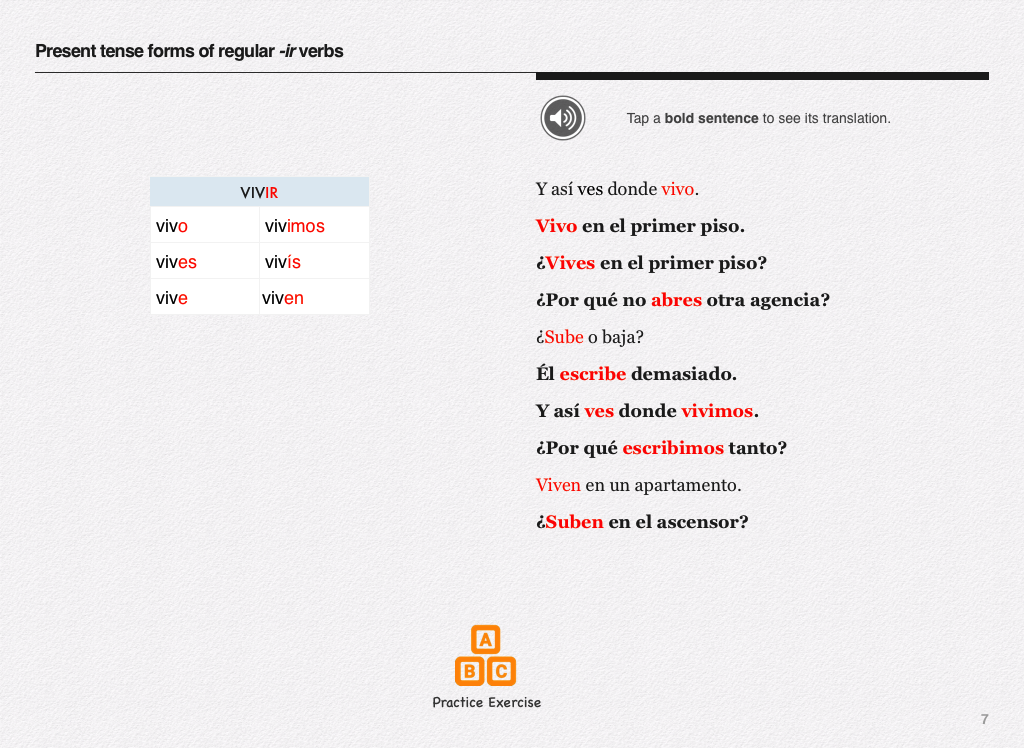
Grammar explanations are presented in the form of tables, short explanations, and example sentences.
Study carefully the tables and read the explanations. Please refer to other grammar books or websites to further your understanding. A site we recommend: Bowdoin College's Spanish Grammar. One of the best Spanish grammars in English is John Butt, Carmen Benjamin and Antonia Moreira Rodríguez's A New Reference Grammar of Modern Spanish, 6th edition. In Spanish, two excellent resources for foreign learners are marcoELE's papELEs (Nivel A) and ELEfante (Nivel b).
Listen and repeat the example sentences, paying particular attention to the words in red. You can tap a bold sentence to see its translation. The other sentences are taken from previous dialogues, and not translated again.
Each grammar point is accompanied by an interactive practice exercise (level 1). This exercise is based on the following oral drills. Doing it carefully, several times if needed, will increase your fluency in the oral drills.
Study carefully the tables and read the explanations. Please refer to other grammar books or websites to further your understanding. A site we recommend: Bowdoin College's Spanish Grammar. One of the best Spanish grammars in English is John Butt, Carmen Benjamin and Antonia Moreira Rodríguez's A New Reference Grammar of Modern Spanish, 6th edition. In Spanish, two excellent resources for foreign learners are marcoELE's papELEs (Nivel A) and ELEfante (Nivel b).
Listen and repeat the example sentences, paying particular attention to the words in red. You can tap a bold sentence to see its translation. The other sentences are taken from previous dialogues, and not translated again.
Each grammar point is accompanied by an interactive practice exercise (level 1). This exercise is based on the following oral drills. Doing it carefully, several times if needed, will increase your fluency in the oral drills.
DRILLS
Language structure patterns which have been learned in the basic sentences are expanded and manipulated in the drills.
Grammar drills are oriented toward the structure of the language to provide a systematic coverage of all important patterns.
Conversation drills (levels 1-3) are designed to systematically vary selected basic sentences from the dialogues within the structures and vocabulary already learned.
All of these drills are planned to be easily and rapidly answered. They are not problems to be worked out like mathematics. There are no tricks in them, and they are not intended as tests.
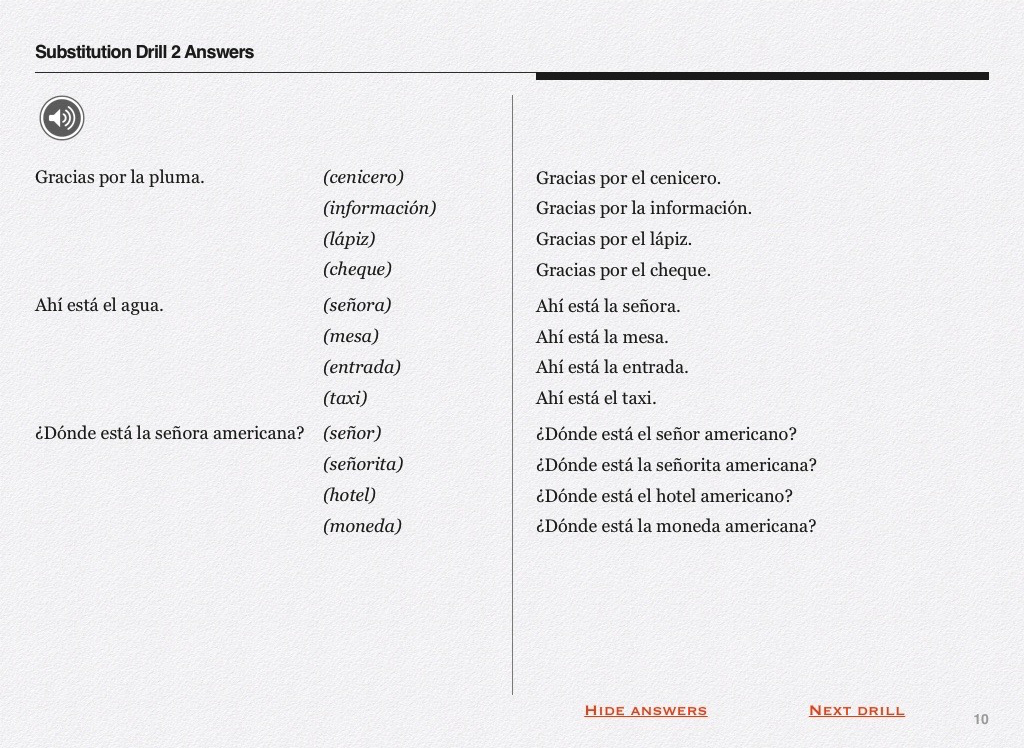
Each drill is presented on two pages: one page without the answers (except a few hints showing what is required), and another page with the answers. Try first to do the drill without looking at the answers, but while reading the question. If you have difficulties, show the answers and start again. Then hide the answers and redo the drill until you can answer without hesitation.
Most drills are self-explanatory.
For response drills, just follow the hints. Depending on the question, you need to answer with the bold words, with the words provided, in the affirmative, or in the negative.
Translation drills may require more thought and time. We suggest first doing them while checking the answers, stopping the recording when needed. Then hide the answers and do them again until you feel you are fluent. Do not aim at perfection. The most important is to think of an approximate Spanish equivalent of the English, and then to repeat the model Spanish sentence provided.
In version 3, translation drills have been replaced by repetition drills. Repeated exposure through repetition is a better way to internalize a new language than translation. If you wish, you can still practice translation by showing the answers (the English translations of the Spanish sentences) and translating back the Spanish sentences.
The drills use only vocabulary which has been previously introduced. Vocabulary items are systematically repeated throughout the course, so that there is no need for separate vocabulary practice. Just do the drills in order, and you will naturally master vocabulary and grammar. To reinforce vocabulary retention, you can also use the flashcards accompanying the lesson dialogues (level 1).
Grammar drills are oriented toward the structure of the language to provide a systematic coverage of all important patterns.
Conversation drills (levels 1-3) are designed to systematically vary selected basic sentences from the dialogues within the structures and vocabulary already learned.
All of these drills are planned to be easily and rapidly answered. They are not problems to be worked out like mathematics. There are no tricks in them, and they are not intended as tests.
Each drill is presented on two pages: one page without the answers (except a few hints showing what is required), and another page with the answers. Try first to do the drill without looking at the answers, but while reading the question. If you have difficulties, show the answers and start again. Then hide the answers and redo the drill until you can answer without hesitation.
Most drills are self-explanatory.
For response drills, just follow the hints. Depending on the question, you need to answer with the bold words, with the words provided, in the affirmative, or in the negative.
Translation drills may require more thought and time. We suggest first doing them while checking the answers, stopping the recording when needed. Then hide the answers and do them again until you feel you are fluent. Do not aim at perfection. The most important is to think of an approximate Spanish equivalent of the English, and then to repeat the model Spanish sentence provided.
In version 3, translation drills have been replaced by repetition drills. Repeated exposure through repetition is a better way to internalize a new language than translation. If you wish, you can still practice translation by showing the answers (the English translations of the Spanish sentences) and translating back the Spanish sentences.
The drills use only vocabulary which has been previously introduced. Vocabulary items are systematically repeated throughout the course, so that there is no need for separate vocabulary practice. Just do the drills in order, and you will naturally master vocabulary and grammar. To reinforce vocabulary retention, you can also use the flashcards accompanying the lesson dialogues (level 1).
REVIEW DIALOGUES
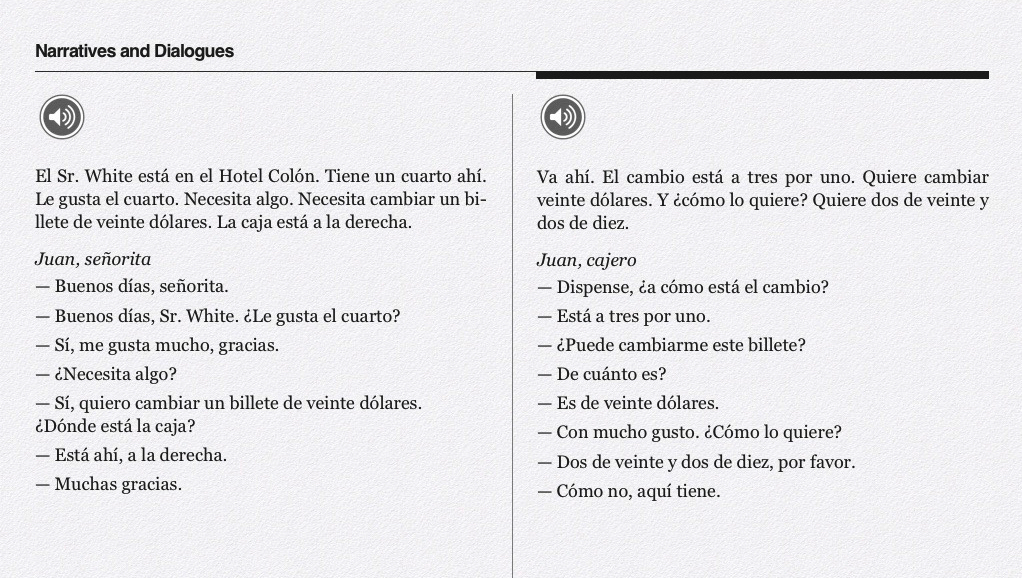
Review narratives and dialogues (levels 1-3) use only known vocabulary and stuctures. They provide further reading and listening practice. They also allow to check if the content of the unit has been mastered.
Audio recordings are provided until unit 16. From unit 17 onward, you should consider these narratives and dialogs as review readings.
Audio recordings are provided until unit 16. From unit 17 onward, you should consider these narratives and dialogs as review readings.
READINGS
STARTING AT LEVEL 2
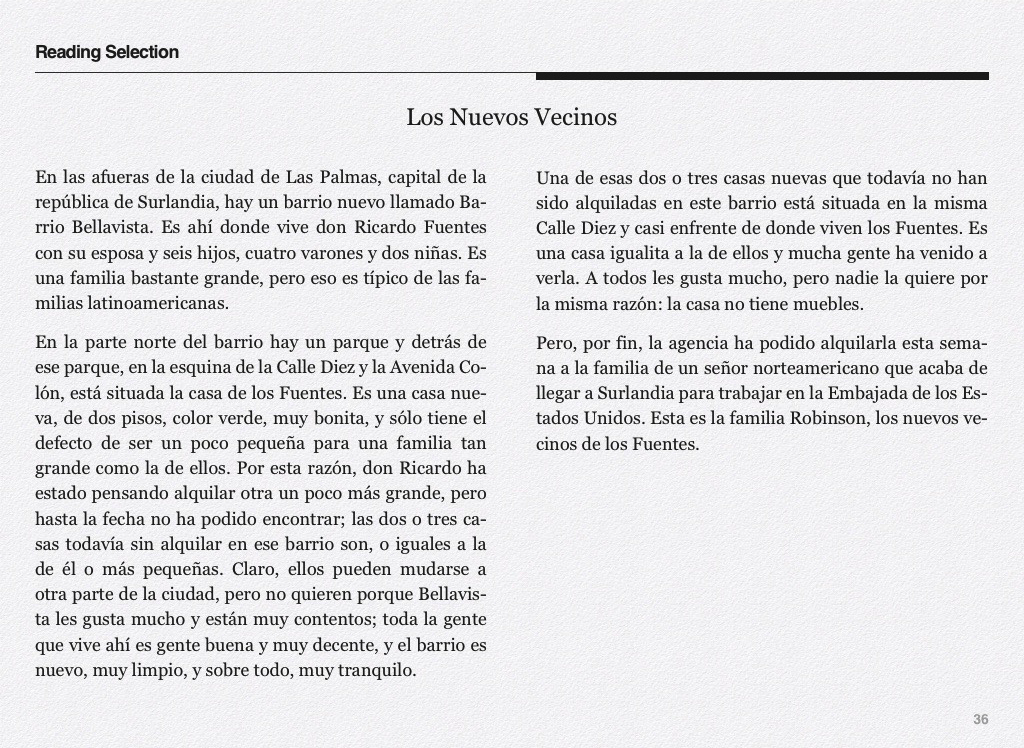
The reading selections (levels 2-4) aim at developing reading skills. No audio recording is provided, as the objective is not listening comprehension but reading ability.
Reading natural Spanish will always present problems of new vocabulary, since writers are drawing on the tremendous lexicon of the entire Spanish language and not just on the vocabulary of this course.
The proportions of this problem are reduced by the considerable number of cognate loan words which English received from Latin and French.
The reading selections are preceded by a list of the cognate loan words that have not occurred before their appearance in the reading that follows. Be sure that you can identify their meaning, and look up in the dictionary any items that are not clear to you.
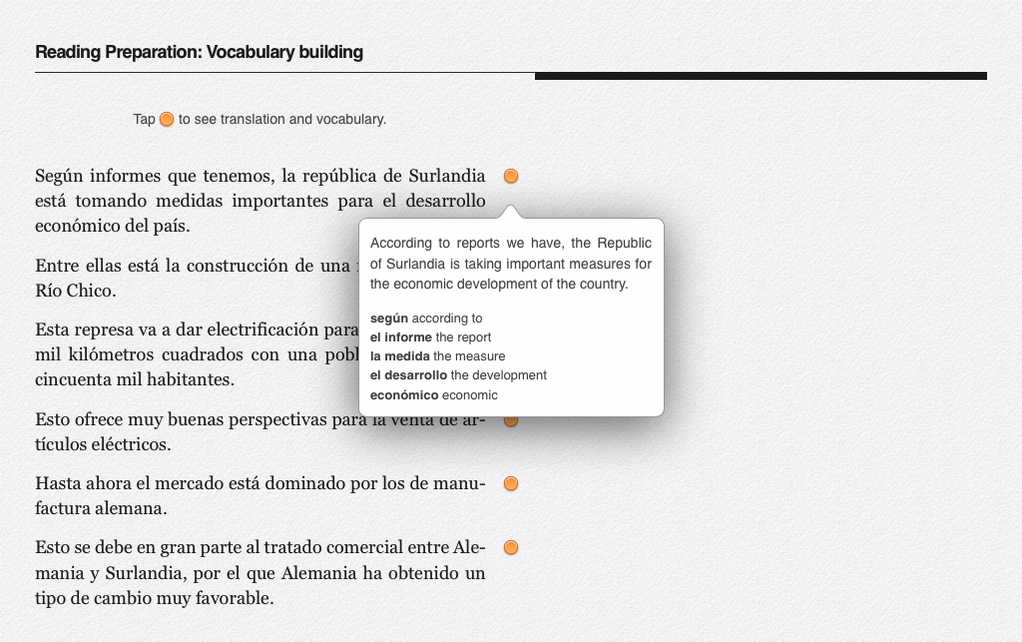
Level 3 reading selections are preceded by vocabulary building sentences. Translations and vocabulary breakdown are available through pop-over bubbles.
Go over the reading selections several times until you understand them well. There is no need to memorize anything, just to read and understand. The rest will come naturally, and soon you will find yourself reading with ease increasingly complex texts.
Reading natural Spanish will always present problems of new vocabulary, since writers are drawing on the tremendous lexicon of the entire Spanish language and not just on the vocabulary of this course.
The proportions of this problem are reduced by the considerable number of cognate loan words which English received from Latin and French.
The reading selections are preceded by a list of the cognate loan words that have not occurred before their appearance in the reading that follows. Be sure that you can identify their meaning, and look up in the dictionary any items that are not clear to you.
Level 3 reading selections are preceded by vocabulary building sentences. Translations and vocabulary breakdown are available through pop-over bubbles.
Go over the reading selections several times until you understand them well. There is no need to memorize anything, just to read and understand. The rest will come naturally, and soon you will find yourself reading with ease increasingly complex texts.
APPLE BOOKS FEATURES
Our books include all the Apple Books built-in features. You can:
- look up the definition of words in Spanish and Spanish-English dictionaries
- have all non-recorded texts read by high quality text-to-speech Spanish voices
- bookmark pages, highlight passages and make notes
- sync bookmarks, highlights and notes with your other devices
- and more